Delco officials decline to answer questions about council president’s tax delinquencies
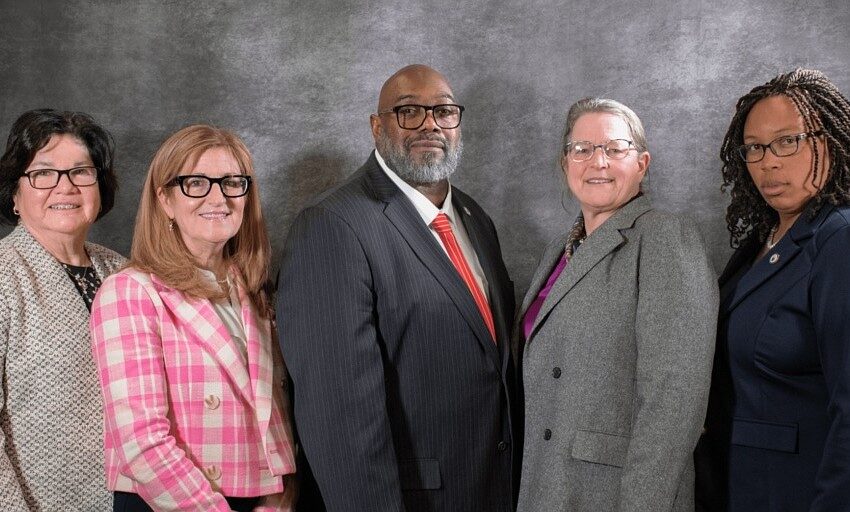
The Delaware County Council — and especially its council president Richard Womack — are declining to answer key questions about Womack’s tax delinquency on two properties in the county.
Last week’s revelation of Womack’s outstanding tax balance is made all the more salient given the county raised taxes 48 percent in just the last three years. The last two years saw increases of 24 and 19 percent, respectively, and generated widespread public outrage. Womack was a ‘no’ vote on the 24 percent hike for 2025’s tax rate, a vote that came just before a re-election run. He voted ‘yes’ on the 19 percent increase for 2026.
Because several of the hikes were applied atop prior increases, the cumulative effect is that county property taxes are now up more than fifty percent compared with three years ago. Despite the anger, the all-Democratic board easily fended off two Republican challengers in last year’s elections.
Womack, who was elevated to be the council president after winning re-election, is estimated to owe about $91,000 in property taxes for two different addresses. Not all of that balance is due the county, and instead is spread across county, municipal, and school districts.
Broad + Liberty sent a detailed request for comment to the county last week, and the county’s response sidestepped all of the questions.
The other five members of council declined to elaborate if they knew of Womack’s delinquencies when electing him council president for 2026 and whether it was appropriate for him to continue serving in that role.
Womack, for his part, declined to offer any additional specifics on his payment plan, which he acknowledged in a council meeting last week when the issue came to light from county resident Charlie Alexander.
In last week’s council meeting, Womack acknowledged he was on a payment plan and that he was “up to date” on those installments. But he and his colleagues are still not offering additional details such as how long the delinquencies existed before the payment plan began, interest rates or penalties, or the date of the most recent payment — the kind of information that could allow citizens to judge if the county is applying the same enforcement standards to elected officials as it does to ordinary homeowners.
In response to these questions, the county only urged other residents behind in their taxes to be in contact with the governments to negotiate payment plans.
“Delaware County Council Chair Richard Womack is one of nearly 600 residents on a payment plan for property tax obligations” said county spokesman Michael Connolly. These payment plans are a way to work with residents to keep in compliance with property tax responsibilities, and do not preclude any resident from maintaining employment or continuing to serve their neighbors. We encourage any resident with questions about establishing a payment plan for property tax obligations to contact our Treasurer’s Office at 610-891-4273.”
Alexander, when revealing Womack’s delinquencies, compared the situation to Gloria Gaynor, a 91-year-old Jamaican immigrant whose Upper Darby home was taken from her last year via an “upset sale,” by which the county can recover unpaid taxes.
According to a 6ABC report last year, “a Lancaster-based real estate firm bought Gaynor’s home from the Tax Claim Bureau in September 2022 for just $14,419 — the price of her unpaid taxes plus fees and penalties. After several failed attempts by Gaynor and her family to appeal the sale and redeem her property, the company acquired the deed to the home, now valued at $247,000, this spring.”
Womack addressed Gaynor’s plight in responding to Alexander.
“While we don’t commit in detail on particular cases, it does illustrate the difficulty of our treasurer’s office faces in which they cannot force a response to numerous, repeated forms of outreach. They are required to follow the law, and when responsible arrangements have been made within a set time frame, a home must go on in to a tax sale process,” Womack said, appearing to read written remarks on a piece of paper.
Womack further said he personally reached out to try to be helpful to Gainor’s family, but did not elaborate further as the council meeting returned to public comment.
In 2013, WTAE in Pittsburgh ran a report detailing numerous school district officials who were partially responsible for tax hikes but were behind in their own taxes. The investigation “found 27 elected school board members in Allegheny County who have tax liens totaling $412,862.”
Democrats began to wrest control away from Republicans in 2017, at first only winning two of the five seats on council. Then in 2019, it won the three remaining seats to capture complete party unanimity after more than a century of Republican control. Unlike every other county in the commonwealth, Delaware County’s charter does not have a provision that mandates reserving one seat for a minority party.
Having run on a platform of deprivatizing the county prison and creating a county-wide health department, the new majority went to work on their promises and soon instituted them.
Those efforts, however, have increased spending.
For example, as the county was still in the process of deprivatizing in 2021, it hired a consultant to model various forecasts for annual expenditures based on different assumptions. The top-end forecast showed an annual cost of about $49 million. The 2026 adopted budget shows $59.3 million allocated in 2025, and $60 million for 2026 — millions of dollars that have added up since the deprivatization went into effect in early 2022.
The county health department, while majority funded through state supplements and grants, nevertheless requires some contribution from the county’s general revenues, although it’s hard to ascertain exactly how much in the last two years.
Before voting ‘no’ to the 2024 tax increase of 19 percent, Womack urged the county to create a citizen-led task force to make suggestions on how to trim the budget. While the county did convene that task force, it never released the dates and times of meetings, possibly in violation of the Pennsylvania Sunshine Law. The county did not release names of participants until November, and then, only in the face of unscheduled interviews with this reporter.